

by Edward Duray
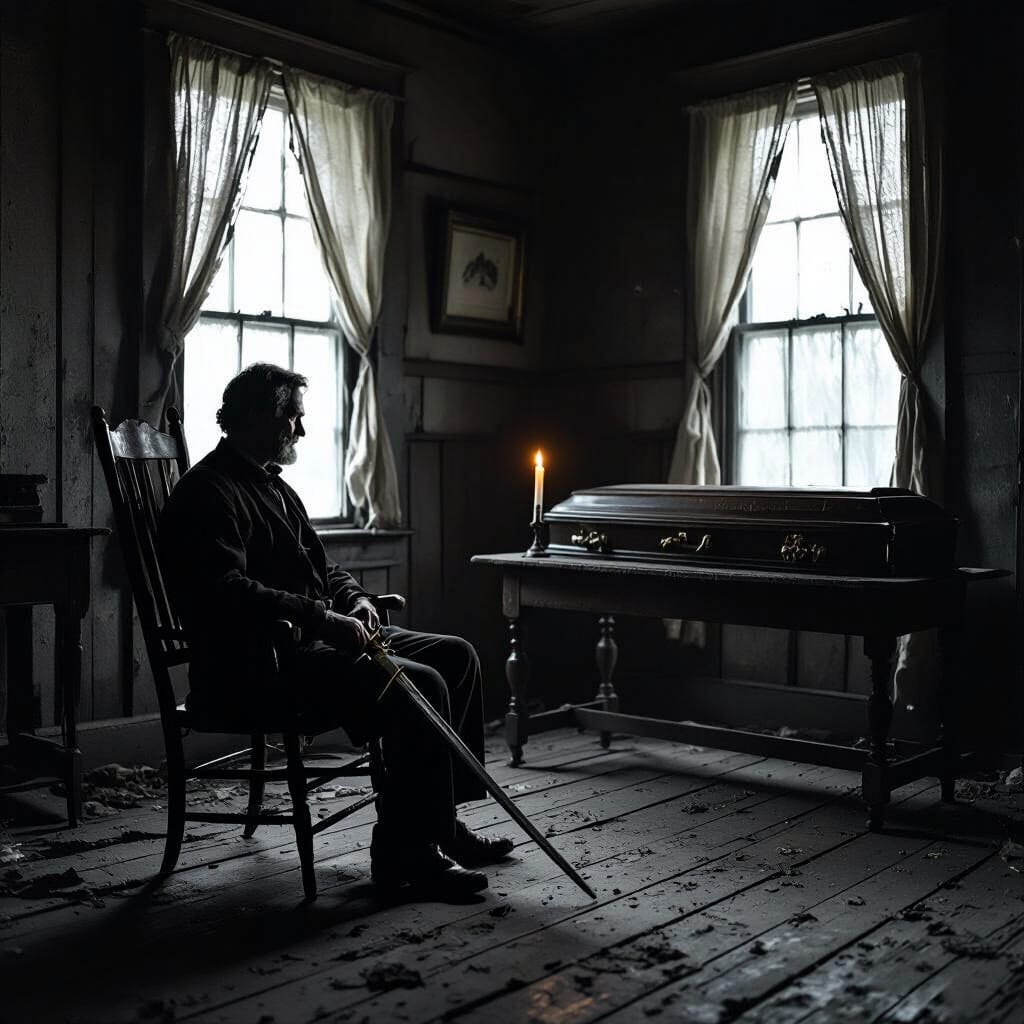
My Grandpa lay in a pine box on a worktable they’d put in his living room, and I didn’t like sitting up all night with him alone. When I heard a footstep on the front porch, I jumped up and hurried to the screen door.
Through the wire mesh I saw a man with a face the color of an albino worm and skin that had an eerie dull sheen like pooled wax. He wore a denim shirt the dull color of a creek turtle. Corn silk hair was plastered in random patches on his narrow dome and his ears jutted from the sides of his head like rubber handles. A puckered scar ran along his right jawline where I had cut him with a pair of grass clippers thirty years ago.
“It’s me,” he said.
“Hey, Eddie,” I said, “You coming in?”
I hadn’t seen him in twenty years, and, like the rest of my Southern relatives, I hadn’t written to him or even called him on the phone before I showed up the day after Grandpa died. The only reason I knew that the old man had passed was because my Cousin Cindy had sent me an email. I was so out of touch, that when I got there looking for Grandma, I found out she’d died two years before Grandpa.
“If you open the door,” he said.
I held the door open and he walked inside, stepping around me carefully like a farmer avoiding a pile of shit. The door hinges made a noise like bad brakes.
“You it?” he asked.
“Yeah. You want something to drink?”
“Not in the same room with dead kin,” he said, jerking his thumb at the casket as he peered at me through eyes the color of iced tea.
“Got here kind of late, didn’t you?” I asked.
“They do that up where you’re from?”
“What?” I asked.
“Drink and eat by the dead like them Irish do.”
“You want to sit down?” I asked.
“I ain’t gonna stay long,” he said, “the haints will be coming.”
“They live around here?”
“Say, you been gone a long spell, ain’t you, Skeeter?”
“I go by Norm now,” I said.
“Yeah, well the haints don’t pay no mind to what you call yourself.”
The haints.
I stared at Eddie and I thought that if I pushed my fingers deep into his waxy skin, that his face would stay in whatever shape that I molded it.
He pointed at Grandpa’s casket and said, “Tonight, the haints’ll come lookin’ for him.”
Eddie was everything that I hated about the backwoods South, and hearing him talk made me glad my dad had moved north. Overhead, a pinecone hit the tin roof and clattered down to disappear into the ground fog that huddled near the back porch.
“Yeah, well,” I said, “I guess that’s why Cousin Cindy has me staying with the casket all night. Her husband was too sick to do it, and I just happened to show up from the airport in my rental car in the nick of time.”
“Her old man ain’t sick,” said Eddie. “He’s ascared. You had any sense you’d be ascared, too.”
I gazed around at the space that was front room, living room, kitchen, bedroom, and now funeral parlor all rolled into one. A pot-bellied wood stove squatted in the center of the floor like a fat black toad hunkered down on four iron legs. The furniture scattered about the room had probably been picked up at some backwoods auction where bidders held up flyswats with taped numbers to signal their intentions. Red and white checked curtains hung over the windows like dead fish strung on a pole. The bathroom was an outhouse in the cow pasture. A hand-pump well outside near the root cellar was the only source of water.
“I don’t see why we didn’t just take him to a funeral home,” I said.
“That ain’t the way we do it down here.”
“So I’m supposed to sit here all night with his casket on a table?”
“It’s the viewing,” he reminded me. “So the neighbor folk can come to see and the kin can keep the haints away. Nearest parlor is fifteen mile over the mountain and ain’t nobody there gonna stay up with his earthly remains to keep the haints away.”
It was my Grandma that told me about them first. Stay away from the dark hollers where things smell bad, Skeeter; that’s where the haints hide and wait for little boys and wayward souls. There were plenty of dark hollers that smelled bad around Heber Springs, Arkansas, and trailers on sequestered hills where the county cops wouldn’t venture unless accompanied by the state police.
“What’s that?” Eddie asked, and he pointed a thin-fleshed finger at the saber. I’d it left lying sideways across the seat of a roughed-up pine rocking chair sporting a cushion the color of a browned apple core.
“Civil War piece I found with a metal detector in Chattanooga and had restored.” I said. “I was going to give it to Grandpa but never got around to it. Now that he’s gone, I thought he’d like it if I buried it with him.”
“So’s he’d be remindered for all eternity that we was stomped by the Yankees? Bad enough his grandkin left the Springs to live up yonder like heathens.”
“Up yonder” was what the people of the Deep South called the states North of the old Mason-Dixon line. My Grandpa told me once that it was where the Devil sent condemned souls to live when he ran out of room in Hell.
“Eddie,” I said. “I don’t even know exactly what it is I’m supposed to be doing here. Let’s just sit down and kick back. What do you say?”
“They’s comin’,” said Eddie in hushed tones. “I can hear them movin’ up the path.”
Eddie’s eyes darted about the room looking for a place to hide. The right corner of his mouth spasmed as if it were touched by a hot wire. He waved his hands at the inside front door as though to slam it shut against whatever evil spirits he heard coming our way. His scar pulsed with fear, and I remembered the day I cut him for locking me in the root cellar so I wouldn’t tell Grandma why his pants were torn.
“Calm down, Eddie,” I said. “You’re whigging out on me here. Let’s get logical. I don’t believe in haints and whisperings. Just get a grip.”
He jerked his head in my direction and slapped his hands over his ears. The corner of his mouth still jerked, and his eyes were wide with fear.
“You been gone too long,” he said. “You ain’t rememberin’.”
A faint smell moved through the front screen door, and I remembered my Grandma gutting and cleaning a possum in the white porcelain sink near the back window.
“I gotta hide,” said Eddie.
I noticed for the first time a dark patch on the left front side of his shirt. A scarlet-black stain had spread from a tiny rip and dried in the shape of a dark bird with its wings spread wide.
“You okay, Eddie?” I asked.
He took his hands away from his head and leaned in toward me.
“Cain’t you hear them?” He whispered near my ear.
Maybe I did. I looked through the screen door and could barely make out the shape of a compact mass of darkness moving toward us through cloud-filtered moonlight.
Eddie hissed, “I’m goin’ out back. I’ll hide in the trees. Don’t you listen to nothin’ they say, Skeeter. Hear me? Nothin’. They lie like Satan himself. Hear me? I’ll be back when they’s gone. You don’t listen to them or do what they say, and they cain’t hurt you.”
And he slipped out the back door like a possum slithering under a porch.
My lungs filled with dread, and I struggled to slow my breathing. I searched about the room for a weapon and my eyes caught the glint of the saber that lay on the chair. I was about to pick it up when I heard a noise on the porch and whirled around to see an old woman standing in front of the door looking like a fairy-tale crone.
“Lost your manners, Skeeter?” Her voice was a coon moving through cattails.
My mouth parched, and the skin between my shoulders blades began to prickle as though charged with electricity. I opened and closed my hands reflexively, and rubbed them together to brush the baby spiders of fear from my fingers and palms.
“I know you, don’t I?” I asked. My words came out as nervous as my heartbeat.
Her hair was the dry gray of a wig they sell in drugstores, but it looked like it was her own. It was brushed back and held tight to the side of her head. I stepped up close to the screen, and saw there was not a wrinkle on her face, as though the skin of her forehead and cheeks had also been pulled back and pinned in place like her hair.
She propped her fists against either side of her thick waist and said, “You goin’ to let old Maudie in, Skeeter? Aunt Maudie had to walk the mountain path all by herself. I brought you things you needs and things you needs to know. Witchin’ hour’s comin’ Skeeter, and you’d best let this old conjure woman in.”
As I reached for the door handle, it felt as though she were reeling me in toward her like a catfish with a hook stuck in its throat. Her eyes held a queer, childlike delight that seemed out of place in the home of a dead man.
“That’s a good boy,” she purred, “now invite old Maudie in.”
“Please come in, Aunt Maudie,” I said with a voice as flat as a windowpane.
I held the screen door open for her, and as she maneuvered by me, her smell of cinnamon and curdled milk made me dizzy. The sound of her flowered dress rustling past me was of a stiff bristle brush pulled across a washboard.
My Aunt Maudie approached the casket and stopped only a few inches away from it. She clutched a black velvet bag large enough to carry a possum head; it was cinched at the top with a worn golden ribbon. After placing it on top of the casket and murmuring a few words to herself, she ran her hands along the pine box, almost caressing it with her fingertips.
“Aunt Maudie—” I said as I came over to her.
She twisted around to face me, held a finger up to her lips, and shushed me like a librarian. I stopped where I was and closed my mouth. Over her shoulder, I saw that the back screen door was barely open, and for a moment I wondered exactly where Eddie was. He had been running away since we were kids. Tonight was no different. Aunt Maudie turned back to feeling up the casket. “Warned you never, never to come back, didn’t I, Skeeter?” she asked over her shoulder.
I was about to offer her something to drink to get her to change the subject, but then I remembered what Eddie had said about drinking near the dead.
“It’s been a long time since I lived summers down here,” I said.
“Got a dark fog in your head, don’t you?” she asked, still facing the coffin. I saw the back of her age-mottled hands run across the casket latch as though making sure that it was secure.
For a brief moment I clenched my hands. I wanted to tell her to lose her accent and speak like a normal person, but then I remembered we were down South, and she was speaking like a normal person. It was me that wasn’t right.
“Can I offer you a chair, Aunt Maudie? Aunt Maudie, are you listening to me?”
She turned to face me again with her head crooked at an angle. Her mouth parted before she spoke, and I saw her teeth were the color of boiled chitlins.
“Your Grandpappy was a evil man,” she said.
“What?”
“Evil,” she repeated. “The haints touched him, and he touched the young’uns.”
Her black-pea eyes seemed to envelop me, and I felt as though my life was leaking out the pores of my skin.
“What did you say?” I asked.
“The haints touched him, and he touched the young’uns in bad places.”
Her hands extended toward me with a canning jar she had taken out of her bag; it was filled with a milky fluid that looked like it had been drawn from a pierced boil. An indistinct memory from my childhood of similar jars stacked throughout a house that could have been hers, floated through my consciousness, and then burst into the black fog of forgetfulness.
My breath hitched as I said, “What are you talking about? He touched kids? What are you saying?”
“Black fog,” she said. “Cain’t look back through black fog. I told you never to come back, didn’t I Skeeter? But soon’s you heard ‘bouts it you had to come and see, see for yourself that the bad man was dead.”
“Aunt Maudie,” I said. “You’re going—you’re losing—I think you’re under a lot of stress.”
I looked past her at my Grandpa’s coffin and felt panic pulling at my chest.
“Take it,” said Aunt Maudie. “Take it. I tinctured it m’self for you.”
She pushed the canning jar at me again.
“What’s it for?” I asked.
“Take it,” she repeated.
I took it from her hands and held it out before me. The surface felt as cool as the outside of a glass of iced lemonade. When I was a boy, I used to shake Mason jars of cow milk for my Grandma, until the cream would rise to the top and she would pour it through a linen cloth to recover clumps of butter. But Maudie was a conjure woman; whatever was in her jar, it surely was not milk.
“Haints come for you,” she said, “you take that lid off and splash some of that on them. It’d stop them dead,” she added, “if they was ever alive.”
I looked down at the brass-colored lid and said, “I don’t need this, Aunt Maudie. He’s dead. And there are no evil spirits coming for Grandpa. That’s just superstition, Maudie. The dead are dead, and that’s all there is. Okay? I’m sorry.”
She ignored me. Her eyes had fixed on the Confederate saber that lay across the rocker-chair where I had left it. She looked at me again and pursed her lips.
“You brought that shiny big knife there with you, didn’t you, Skeeter? Oh, maybe Skeeter remembers ‘nough to bring a big knife.”
I flushed and told her what I had told Eddie— that I had brought it to bury with Grandpa.
“That right?” she asked. “A big knife like that?
“It’s a saber,” I said.
“My, my,” she winked, “how you have grown. A big man with big words. But you won’t be needin’ that big knife of yours. Aunt Maudie done fixed things.”
As small as my grandparent’s place was, it seem to grow smaller around me, until I found breathing to be difficult, as though my lungs were being squeezed by the house itself.
“What are you talking about?”
She reached up, grabbed me by the ears, and pulled me so close to her own face that I thought that she was going to kiss me with her parched lips. Instead, she twisted my head by tugging on my left ear to bring my right close to her mouth.
“Aunt Maudie’s the one found your Grandpappy’s cold remains. I knew he’d be comin’ back, that one. Coming back for his special one. The haints would be marchin’ into this world draggin’ his filthy soul behind them. So, Aunt Maudie fetched a Madstone cut free from the innards of a deer, and stuffed it into that old demon’s sticky-gum mouth, and with your Grandma’s own needle and cat-gut thread I sewed his lips shut so tight he cain’t whisper a word of evil.”
She turned my face toward hers again by tugging my other ear and placed our foreheads together.
“You go sit yourself down in yonder chair with your big knife in your one hand and the jar Maudie bringed you t’other. When the sun breaks the trees, you come find your way to Maudie. We gots dark things to ponder.”
Her fingers let go of my ears, but even though I saw her turn and walk out through the screen door, I could still feel the pressure of her fingers. Moments later, I heard her soft, cackling laugh, and I had to fight back the urge to vomit.
I set the jar she had given me on the floor beside the rocker and was about to pick up the saber and sit down as she had told me to do, when I felt a movement behind me.
“Haint’s done possessed her,” accused Eddie. “She’s a conjurin’ woman, and she talks to the whipserin’s in the dark hollers.”
He moved around me, and his eyes held mine.
“She said some bad things about Grandpa, Eddie,” I said.
“Haint possessed,” he fired back. “Cain’t believe nothin’ she says. Cain’t do nothin’ she says. Haint possessed.”
“She said he touched children.”
“You believe that,” he asked, “‘bout your own flesh and blood?”
“She said she put a Madstone in his mouth and sewed it shut to keep him dead.”
Eddie’s lips squeezed together into a thin, red line.
“Desecratin’ the dead,” he pronounced. “She done defiled the body of your own Grandpappy. Stuffed a Madstone in his mouth and sewed his lips together like he was a voodoo doll. You got to take it out. Take away the evil.”
I stared at him. He had the wide stare of a preacher man telling his congregation to dance with snakes and drink down poison.
“Eddie, are you out of your backwoods mind? I am not opening that coffin and taking that Madstone out of Grandpa’s mouth.” I moved in so close that I could see the pores in his face and then held my finger right in front of his nose. “What I am going to do is wait until morning and then go get the Sheriff and report this and let him handle it.”
When he moved forward, I stepped back, almost losing my balance.
“You got a sacred duty,” he declared.
I swallowed and said, “Eddie, I got squat. I don’t even know why I’m down here except I thought I’d be going to a funeral for my Grandpa. I didn’t sign on to be opening coffins and messing with the dead. You want to do it, you go right ahead.”
Eddie kept coming, and he backed me right up against the rocker. I could feel the spine of the saber when it pressed against my leg.
“You’re his special one. That’s why you gots to do it. Grandpappy’s special one, that’s who you are.”
When he said those words, I felt sick to my stomach. I remembered what Aunt Maudie had said, and an evil memory began to scratch its way up through my mind. Before it could pull its way into my conscious thoughts, I felt the black fog cloud my head.
“There’s scissors on the kitchen table,” he pressed. “Git them and bring ‘em here. Open the box and snip the threads. Then open his mouth and pull that blackness out of it so that he’s buried clean in God’s green earth. You want your Grandpappy brought ‘fore the Pearly Gates with the stain of that witch woman’s black magic sewn in his mouth?”
“No.”
“’Fraid of the conjure woman, Skeeter, or ascared to touch dead kin?”
I stepped to the side, closer to the casket than I wanted to be, but away from his eyes.
“Used to be you wasn’t ascared of nothing,” he said, turning toward me.
“I am not afraid of doing it; it’s just not my place.”
“Liar,” he spat.
“Watch your mouth,” I said.
“Gonna cut me again? Too chicken to help your poor dead Grandpappy but gonna wail on poor old Eddie? What happened to you, Skeeter? Ain’t you got no family soul? You gonna let the Sheriff handle family business? You want folks to know your Aunt Maudie put a Madstone in Grandpappy’s mouth and you did nuthin’ to make it right? Sheriff finds out about this, every folk will know and ain’t none of us gonna be able to hold up our heads in public no more. You the eldest, Skeeter. You the special one. You got to do it for the family.”
Family.
Eddie and the rest were all I had now. Everyone up North was dead. My father and mother died, and I was an only child. The only thing I had left in life was family, and for years I had done what my father did. I had ignored them. I had pretended they didn’t exist. For the most part, I had thrown their Christmas and Birthday cards in the wastebasket and sent none in return. Cindy had held three family reunions in Little Rock and neither I nor my mother and father had shown up. We had treated them like they were as dead as Grandpa.
“Where are the scissors?” I asked.
“They’s on the table,” he nodded. “Sharp as the day your Grandma was snippen’ cloth.”
I walked over to the kitchen table and there, next to a dusty crystal vase filled with cobwebs, lay the scissors, open halfway and ready to cut. I saw movement in the gossamer, and then a shiny, brown, segmented leg poked through to touch the inside of the cut glass. With my left hand I picked up the scissors, and with my right I flipped the vase over so that its open mouth was face down against the red and white-checkered tablecloth.
“You gots to hurry,” said Skeeter.
My Grandpa’s casket was made of rough pine slats with three tarnished brass hinges on the back that looked so old they had probably been pried off a storage shed. The hasp was not locked. When the latch was closed over the coffin, an inverted half-moon of rusted metal poked through it and twisted to hold the latch in place. My Grandpa was to be buried in spare parts and salvaged wood. I saw a few metal staples in the boards where shingles had been ripped off with a claw hammer.
The piece that twisted to hold the latch broke off like dry chocolate when I turned it. It hit the plank floor without a sound. The air had gone thin and cool in the house. I listened hard, but I could not hear Eddie’s breathing from where I stood. My breathing sounded like an old farm truck laboring up a dusty hill. The faint odor of outhouse sludge seemed to drift up to me from the box.
My fingers clutched the scissors in my left hand like they were an ice pick.
“Come on, Skeeter,” said Eddie from somewhere behind me, “you gots to get this thing done.”
I wanted to spin around and stick them right in his eye, but I took a deep breath and tried to calm down.
“A body’s a body’s a body,” I said.
“What’s that?” Eddie called.
“Nothing,” I said.
The lid weighed less than a cellar door, and I lifted it high and walked around the box to lower it and let it rest on the other side. My eyes stayed fixed on it without looking at the contents. When I stepped over to the head of the makeshift casket, I closed my eyes quickly and squeezed the lids together as though to keep out acid.
“Gots to do it, Skeeter,” Eddie said. “You gots to hurry.”
The outhouse smell filled my nostrils again. I remembered lying in bed at night as a child, afraid to go out after dark and walk to the outhouse by myself. A lantern’s light was no help at all against the haints. So, I had lain in bed, trying to sleep, praying I could hold it in until morning.
Once, on a night with no moon and a chill in the thin air, I had to go out to use it. I had to go by myself since I thought everyone else was asleep. I remembered stepping off the porch and into the cool white vapors that stretched before me like a sea of thin clouds covering the cow pasture. The outhouse rose in the middle of that diaphanous mist like an abandoned church. I had Red Ball Jet tennis shoes on but no socks, blue jeans torn at the knee, and a t-shirt with yellowed armpits that was as long as a bath robe. As I walked toward the pasture, I felt long grass and weeds slap dew on my bare ankles. The lantern cast a jaundiced light across the ground-clouds, and moved back and forth, back and forth, with each swing of my arm.
As I got closer, I heard rustlings and whisperings that seemed to come from the outhouse. I stopped. The yellow lambency of my lantern shivered as my hand shook. I looked back toward my grandparent’s house and began to cry. I had to go to the bathroom but couldn’t walk a step closer.
The whisperings that moved inside the outhouse were getting louder. I could hear words that sounded as if they were being spoken beneath a pile of blankets or underneath my bed.
I thought my grandparents were still sound asleep in the house.
I had to go to the bathroom.
I crossed my legs.
I heard my Grandpa’s voice call out to me from the outhouse, his voice thick like sawmill gravy.
*****
Eddie pulled me back to the room, to the open casket.
“Ain’t no time for lolligaggin’,” he said. “Snip them threads and pull out that blackness.”
My Grandpa was dressed in a checkered shirt, bib overalls, and workboots. I was facing the top of his bald head, and I stared at the islands of brown spots that covered his pate. Three hairs a quarter inch long sprouted like thick stalks from the tip of his attenuated nose. His face was oily brown wrapping paper glued to a thickly chinned skull. I could see that his eyelids were closed, but as I looked at them, I was afraid that they would pop open and expose eyes, not milky colored and empty of awareness, but the eyes of my Grandpa—quick and predatory as a night owl hunting mice.
His lips were folded inward and sewn tight with neat, regular rows of catgut, like the edges of a dime store purse. Although I took in the rest of my Grandpa’s body with my peripheral vision, my eyes couldn’t pull away from his threaded lips. I knew but could not accept that my Aunt Maudie had actually stood over his dead body with a length of catgut and shoved the point of a needle through his flesh.
“Do it, Skeeter.”
I glanced at Grandpa’s chest.
No movement.
It didn’t go up, and it didn’t go down.
If his eyes popped open or his chest started moving, I would leave the lid wide and knock Eddie over and I’d be straight through the screen door without even opening it.
“Hurry,” he hissed.
I transferred the scissors to my right and bent slightly at the waist. The anesthetic smell of lingering putrescence numbed my ability to think. My body felt slightly insensate as I reached my hand forward and slid the tip under the first thread. I closed my eyes and clipped. When I opened them, I counted and saw that I had five more to snip. She had sewn six stitches.
My back felt uncomfortable, so I leaned over to place my left hand on his forehead. I stopped it three inches above his skin, thought better of it, and slid it over to the edge of the casket for support.
His eyes were still closed; his chest had not moved.
I clipped the next stitch.
It was like snipping the wicks from unlit candles.
Three, four, five.
Each snip tugged and pulled at the edges of the holes in Grandpa’s lips. With the fifth snip, the scissors sliced into his lip, and as I pulled the blades away, I expected him to bleed, but his heart no longer pumped. A viscous material the color of dirty brake fluid oozed to the surface where I had cut him and pooled just below its edge.
A slight tremor was moving through my body by then, and it took me three tries to clip that last catgut thread, but I got it.
His mouth flew open as a spout of furious black air blasted out and up to the ceiling and spread like an upside-down septic pit over my head. Grandpa’s head shook like his corpse was having a seizure and a hideous wailing filled the room as though damned souls held captive in his cadaver were screeching for release.
“Git the stone,” screamed Eddie.
I had jumped back from the casket and was cringing by the pot-bellied stove. The air over my Grandpa swirled like a maelstrom of coal dust, and the screams made it impossible for me to hear anything else Eddie said. He stood on the other side of the room, pointing at the pine box, yelling at the top of his lungs. I couldn’t hear him, but I knew what he wanted me to do.
Had I not been so afraid that if I didn’t take the stone from Grandpa’s corpse, haints would rip me to pieces and devour me in that very room, I could not have moved from where I stood. But I saw the terror of my own face reflected in Eddie’s own, and I put my left forearm in front of me and walked into the turbulence as I felt my way until I placed my palm on Grandpa’s forehead. I kept my eyelids closed so that the black particles would not get into my eyes.
I slid my hand down his dead face; my stomach was lurching and dry heaves were pulsing up my throat. My index fingernail parted his eyelids by mistake and scratched the gummy residue that coated his eye. I clenched my lips to suppress a scream even as I slid my fingers further, past his nose, and then into the invidious cavity that was his mouth. The fact that I was doing this reprehensible thing was lost in my having stepped past the bounds of sanity.
The shrieks that caterwauled past his lips, that I could feel vibrating through my hand, weakened my ability for rational thought as I jammed my thumb and forefinger past his teeth and muculent tongue until I grasped a hard uneven object the size of a walnut that must have been the madstone. I plucked it out and wrapped my fingers around it. With my eyes still closed, I took a step backward from the source of this hellish cacophony.
I heard Eddie’s voice near my ear screaming, “Take it out the front door, Skeeter. Throw it out into the dark or we’ll both die.”
I opened my eyes, ran to the front screen door, threw it open, and when I stepped out into the cool night air, I wound my arm back behind me and pitched the madstone into the night.
The wailing stopped.
The night was suddenly still.
My eyes grew misty, and my knees wobbled with a sudden rush of relief. I knelt down on the porch and wiped my hands. Some of the viscous substance came off, but a residue still covered my fingers and palms the way axle grease does when you try to wipe it off.
With my head thrown back, I shouted, “I hate the whole damned South. What do you think of that, Eddie?”
There was no answer.
“Eddie?” I called again.
I got up off my knees and turned back toward the house.
“Eddie, are you in there?” I asked.
As I stepped inside, I was reluctant to close the screen door behind me. Eddie was nowhere in the room. The casket lid lay thrown back, and the body of my Grandpa lay still inside.
“I don’t like this,” I said.
I saw the Civil War saber and walked over to it. As I picked it up, I drew it from its sheath.
“Hello?” I called.
Thinking about what had just happened was impossible. It would sort itself out later. At that moment, all I could allow into my mind was the thought of closing the casket lid and getting away from the house as fast as I could.
My fingers wrapped tightly around the saber’s hilt; my hand fit comfortably inside the guard. I held it in front of me like a gun, aiming it from side to side for a moment to make sure that I was alone. But it was a one-room house, and I could see no one else but myself. I was alone.
“Eddie?” I called one more time. Then, when there was no answer, I said, “Every time there’s trouble, you get scared and run away, Eddie. You were a chickenshit when you were a kid, and you’re still a chickenshit.”
I saw the canning jar that Aunt Maudie had brought me still on the floor next to the rocker. My Grandpa’s head lolled to one side, and I immediately stepped to the head of the casket. With my free hand, I took hold of the lid and lifted it up. The hinges squealed like I’d stepped on a cat’s tail. I bit my lip while I was closing the lid down to shut his corpse away forever when his hand moved upward and it grasped the edge of the lid. His fingers moved like the legs of a spider that senses prey.
For a moment I stood where I was, unable to move, but when I saw his eyelids pop open, I took a step back and swung the sword with every bit of strength I had, cutting his arm in two. The casket lid slapped down into place, and I stepped around to the side and with both hands and the weight of my whole body I thrust the saber through a slat in the wood.
A hideous sound that I cannot describe issued from within the wooden box as I ran back to stand next to the rocker. My foot touched the side of the canning jar, and I bent down, picked it up, and unscrewed the lid.
The casket began to shake as a sound came from within it like a baying hound bred in Hell. I stood shaking, clutching the jar as though it were a lifeline. The saber shot back out of where I had thrust it and clattered to the floor. My mouth opened and closed while I tried to scream but could not find the mental coherence to do so.
The lid began to rise.
As it rose, I saw movement within, and my Grandpa sat up. He turned his head toward me, and as he did, I rushed forward and threw the jar’s entire contents onto him. I saw his eyes light up like fire as the milky white fluid launched at him, but when it contacted his body an explosion of boiling, hissing gas erupted from the casket like sulfur gas roiling and bursting forth from a swamp.
I shielded my face and ran straight out the screen door again and into the front yard. My car was fifty feet away in the darkness, and I ran for it as I have never run for anything in my entire life.
It was unlocked, and after digging my keys out of my pocket, I crawled inside and shoved them into the ignition. I cranked it, and the engine came to life. The auto-headlamps turned on, and I spun the car in a circle and tore dirt down the long driveway toward my cousin Cindy’s without ever looking back.
Cindy and her husband looked at me like I had escaped from a mental hospital. When I was telling them what had happened while sitting in their living room and wiping my hands clean again with a towel, one of their children came downstairs and Cindy shooed her and told her to stay in her room.
“You sure you don’t want a shot of screech?” asked her husband. “I’m havin’ one.”
He looked healthier and more coherent than I must have seemed.
“I thought you were sick,” I said.
He looked away and walked toward the kitchen, where they likely kept the bourbon
“No,” I said. “Look, this has to sound crazy, but it happened just like I said. Would I make something like this up? You ask Eddie, and he’ll tell you. Of course, the little asshole took off when it got really bad, but if you’ll just talk to him, he’ll confirm everything I’m saying.”
Cousin Cindy was three or four years younger than me, a sallow-faced woman with stringy blond hair and a full-figured body gone to seed. She was wearing a thin quilted bathrobe cinched at the waist.
“Skeeter,” she said, as she played with her belt buckle, which was cast into the shape of a silver tractor-trailer.
“Norm,” I said. “I am never going by the name Skeeter again.”
“Like I was gonna tell you,” she continued, “Eddies’ been dead nearly a year now. I sent you a letter ‘bout it. Didn’t you read it?”
The room seemed to dim, and I heard a buzzing in my ears.
“Dead?” I asked. “You’re telling me Eddie’s been dead almost a year, and I just talked to him tonight? I’ve got to get out of here, Cindy. I’m leaving now. You guys will have to take care of whatever’s at that house.”
I was backing toward her front door and taking my keys out of my pocket.
“Skeeter?” she asked. “You okay? You been away a long time. You just got to calm down, maybe have a drink like Bud says. It’s a hard time with Grandpappy dying, but we’ll get through it.”
“No,” I said as I opened the door and stepped out onto the porch. “What I’ve got to do is get the hell away from here as fast as I can and never come back. Cindy, I’m never stepping foot in the South again as long as I live.”
I turned and sprinted for my rental car again. As I opened the car door, I saw Cindy’s husband Bud in the front hallway staring out at me. After a moment, he went into the living room.
I dropped the keys into the grass just as I got to the side door. I had been moving so quickly that I wasn’t sure where they had fallen. It took me a few minutes to find them even on my hands and knees, but I did. There was no way I was staying the night in Arkansas— no way. After brushing the dirt off of them, I got into the car and slammed the door behind me. I just got the keys stuck into the steering column and the car started when a shadow fell across my side of the car and out of the corner of my eye I saw jeans and an untucked shirt.
“You can’t change my mind, Bud,” I said without looking up. “I’m getting out of here.”
I turned my head just a little toward him and saw a small rip in the side of his shirt and a dark stain that had spread out from it to make a shape like a bird with its wings spread wide.
“You best not come back, Skeeter,” Eddie said.
I floored the accelerator and shot forward so fast that I crashed straight through Cindy’s mailbox and onto the main road. It was twenty-six hours of driving to get back to Detroit, but although I stopped for gas, I never closed my eyes until I pulled up into my own driveway.
But it was somewhere north of Cincinnati that I began trying to remember something that pricked at my memory like a briar, but even as I sat outside my own garage idling the engine, I still wasn’t certain if I’d ever even had an Aunt Maudie.